
|
Truth
Restored
by Leon Parson Testimony & Symbolism |
| In the spring of 1996, Leon personally
traveled to the Sacred Grove in Palmyra, New York to do necessary research
insuring true accuracy and beauty. Therefore, everything in the painting,
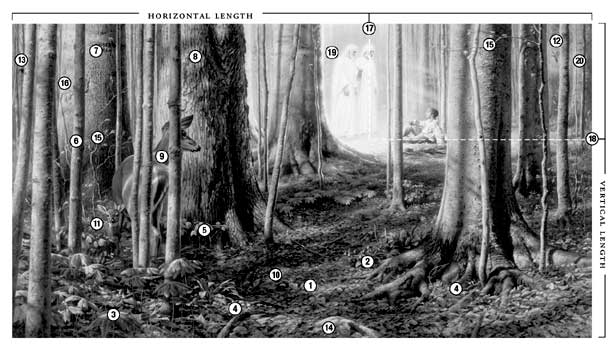
the trees, rocks and plants are actually from the Grove. I believe that the Creation of this earth, the Fall of Adam, and the Atonement of Jesus Christ were brought about not only for all of Mankind, but also for the earth itself and for all forms of life thereon. The Restoration of God’s Kingdom in these latter days is, therefore, of the utmost importance to every thing as well as to every one. This painting serves as my visual testimony of these truths. My hope is that it conveys some of my deepest feelings and helps strengthen the testimony of each person who views it. In communicating His word to man, the Lord uses symbolism, ranging from the sacrament and ordinance of baptism to the rainbow. Symbolism is also an essential element used to help communicate the content of this painting. the following paragraphs explain some of these symbols and their meanings, as well as some of the artistic design principles used. Truth Restored shows budding leaves and blossoming flowers indicating early spring, a time of new life, refreshing, and restoration, making it representational of the actual time the First Vision took place (JS-H 1:4). Trilliums, (1) from the lily family, are the red-petal, three-leaf wildflowers placed in the lower middle foreground. To the above right of this flower, the mottled-leaf, yellow-petal wildflowers are Adder’s Tongue, (2) (an adder is a poisonous serpent). The names of these two flowers suggest the Godhead and Satan or "opposition in all things" (2 Nephi 2:11). The Colloquial name for Trillium is "wake robin," connoting spring, and implies restoration, as if awakened from the deep sleep of apostasy. Other spring plants found in the sacred grove and that add symbolic meaning to the painting as well are: May Apples, (3) the large, leafy plants at the lower left, Spring Beauty (4) the tiny flowers with white, five petal blossoms, and Delphiniums (5). Some of the trees have been painted large enough to portray a mature forest of ash, (6) Beech (7) and Maple (8) as it would have been in western New York in 1820. The Sacred Grove is actually on top of a small hill; the horizon line, therefore, has been painted as a slight left to right uphill angle. The whitetail doe (9), unalarmed, is in the attitude of giving reverence and honor to the Father and the Son, and becomes symbolic as a living witness to this most transcendent event. She is also used as a symbol of virtue, peace and spiritual maturity. The fawns (10) give evidence of spring as well as represent innocence and spiritual immaturity, new birth and restoration. The fawn (11) looking directly at us, is an artistic device used to help bring the viewer emotionally and hopefully spiritually, into the Sacred Grove. The dove, (12) coming into the picture from the far right, represents the Holy Ghost and the New Testament symbol for the "Sign of the Dove" (Teachings pp. 275-276). The raven, (13) shown fleeing from the presence of the Father and Son to the far left, represents the devil (JS-H 1:17). A large stone (14) has been placed at the bottom of the painting and lies directly below the Saviour; symbolic of foundation (Jacob 4:15-17), the "chief cornerstone" (Eph. 2:20) and the "Rock of our salvation" (Deut. 32:4,15). The green moss found on this rock symbolizes three stages of our lives; mortality, immortality and potential exaltation and eternal life through the atonement of Jesus Christ. Throughout the painting, the branches with new buds, (15) are "pointing" to the Father and Son, also symbolic of eternal life. The dead branches (16) on the far left of the painting, point to the raven. Void of life, they are symbolic of eternal or spiritual death. Compositional space divisions and focal points using the Golden Section have been created as a means to prioritize the placement of the Father and Son (17), Joseph Smith (18) and other significant elements of this painting. The Golden Section is a mathematical design principle, 1000/618, discovered, in nature, by the ancient Greeks and used extensively by the Saviour in the creation of this world. It occurs in virtually every living and non-living thing from the proportions of the human face and body, maple leaves and the chambered nautilus sea shell, to the notes of the musical scale and the distance between the planets. Encircling the Father and Son are the primary colors: red, yellow and blue. (19) The same colors can be seen surrounding the dove. They are the most important colors as all other colors are created from them. These three colors relate to the three members of the Godhead, the importance of their eternal roles and the three degrees of glory. Each color has universal symbolic values, as well. Red is used symbolically to communicate the blood of Christ or the Atonement. Yellow is symbolic of kings or kingdoms. Blue is the color symbolically used to communicate both truth and revelation. Hence, Jesus Christ is our Eternal King and the "King of Kings" (1 Timothy 6:15). The First Vision of Joseph Smith was a temporal beginning of the restoration of the Kingdom of God here on earth, and a true revelation as attested to by the "Sign of the Dove." As a focal point color, used symbolically in this painting, blue (20) extends beyond the Father and Son, enveloping the immediate space around them, the dove and the boy-prophet, Joseph Smith. It emphasizes the importance of the revealed truth given to the world from Heaven during this glorious and most sacred event. Leon lives in Rexburg, Idaho with his lovely wife of 29 years, Kathryn. They have seven children and two grandchildren. He has been a member of the BYU–Idaho art faculty for twenty-four years. He served a Spanish speaking mission to Arizona for the Church of Jesus Christ of Latter-day Saints and among other assignments, has served as a Sunday School gospel doctrine instructor, 20 years in the Scouting program and Young Men’s President, a counselor to two Bishops and as a Bishop. Leon is currently serving on his Stake’s High Council. For additional information contact Leon Parson Studio at (208)356-4872 or e-mail: parson@srv.net |
Other works in the Windows of Hope & Inspiration Series
all images are copyrighted by Leon Parson and may not be used
without permission